Why Boot Shopping Is Uniquely Frustrating for Thicker Thighs and Calves
Quick Answer: Standard boot shaft width is sized around an average calf circumference that doesn’t account for a fuller thigh-to-calf taper, which is why boots can fit the foot perfectly but feel restrictive higher up the leg — seeking out wide-calf or extended-shaft-width boot lines, and checking published shaft circumference measurements rather than just shoe size, solves this more reliably than sizing up the whole boot.
A boot that fits the foot but pinches the calf or lower thigh isn’t a sizing mistake — it’s usually a sign the shaft simply wasn’t cut for a fuller leg taper, regardless of overall shoe size accuracy.

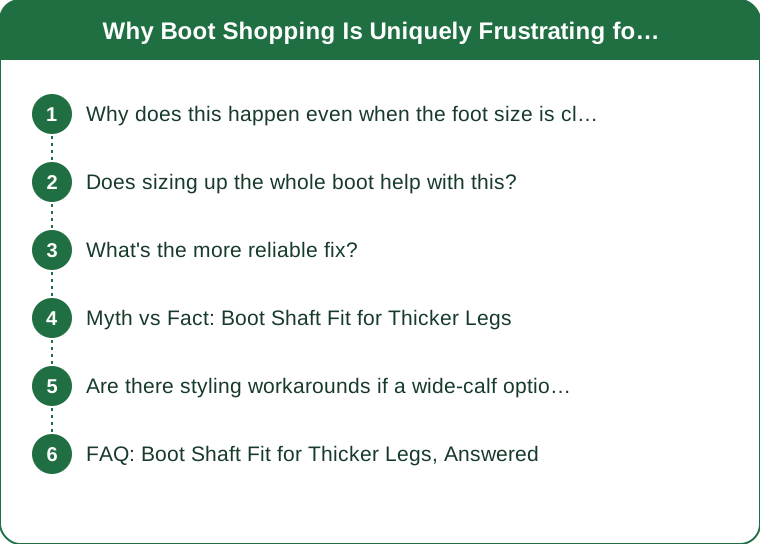
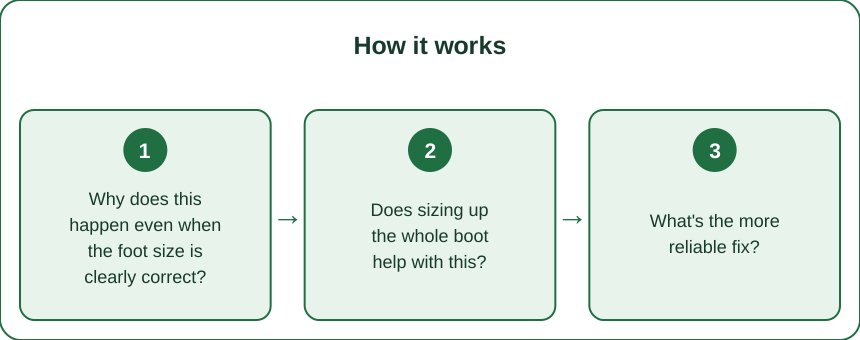
Why does this happen even when the foot size is clearly correct?
Shoe size and shaft width are two separate, independently determined measurements, and most standard boots are built with one shaft width option per shoe size, sized around an average calf circumference for that size range. A fuller calf or thigh taper simply doesn’t fit into that single standard shaft width, regardless of how accurately the foot portion of the boot fits.
Does sizing up the whole boot help with this?
Rarely, and it usually creates a new problem. Sizing up the boot to get more shaft room typically makes the foot portion too large and loose, which affects walking comfort and stability without reliably solving the shaft fit issue anyway, since shaft width doesn’t always scale proportionally with shoe size in standard boot construction.
What’s the more reliable fix?
Wide-calf or extended-shaft-width boot lines, offered by a growing number of brands, are cut with a genuinely wider shaft circumference at the same shoe size — this addresses the actual issue directly rather than compensating through overall sizing. Checking a brand’s published shaft circumference measurement (usually listed in inches around the widest part of the calf) against your own measurement is more reliable than judging fit from photos or standard size labels alone.

Myth vs Fact: Boot Shaft Fit for Thicker Legs
Myth: “Stretchy boot material means shaft width doesn’t matter much.” Fact: stretch fabric or leather can help marginally, but it has real limits — a shaft that’s significantly too narrow will still feel restrictive even in a stretch material, especially after a full day of wear.
Myth: “Wide-calf boots always look bulkier or less stylish.” Fact: many wide-calf lines are cut to maintain a similar overall silhouette to standard boots, just with more room where it’s actually needed — style options have expanded significantly in this category.
Myth: “Boot shaft fit problems are mainly about calf size, not thigh size.” Fact: for taller boots (knee-high or over-the-knee styles), the upper shaft near the thigh matters just as much as the calf, and standard sizing often fits the calf reasonably while still being tight higher up.
Are there styling workarounds if a wide-calf option isn’t available in a preferred style?
A boot with a side zipper that has some give, or a lace-up or elastic panel detail at the shaft, offers more flexibility than a fully rigid, seamless shaft — these construction details, more than overall brand sizing, can make a meaningful practical difference even within a standard (non-wide-calf) boot line.
FAQ: Boot Shaft Fit for Thicker Legs, Answered
How do I measure my own calf or thigh circumference accurately before shopping?
Measure around the widest part of your calf (or thigh, for taller boots) with a soft measuring tape, standing normally — compare this directly against a brand’s published shaft circumference rather than relying on general size or brand reputation alone.
Do wide-calf boots typically cost more than standard boots?
Sometimes modestly more, reflecting the different construction pattern — but pricing varies significantly by brand and isn’t a reliable indicator of fit quality on its own.
Is it worth trying boots on later in the day when legs may be more swollen?
Yes, this is genuinely useful advice — trying boots on when legs are at their largest during a typical day gives a more realistic sense of all-day comfort than a morning fitting.
TL;DR:
- Standard boot shaft width is sized around an average calf circumference, unrelated to shoe size accuracy
- Sizing up the whole boot rarely fixes shaft fit and often makes the foot portion too loose
- Wide-calf or extended-shaft boot lines address the actual issue directly
- Checking published shaft circumference measurements is more reliable than judging fit from photos alone
A restrictive boot shaft on an otherwise well-fitting boot isn’t something to just break in and tolerate — it’s a specific, well-understood sizing gap with real, available fixes.
Keep Reading
This article is for general informational and styling purposes only. Fit, sizing, and product availability may vary.
