Why Thigh Chafing Peaks in Late Summer and What Actually Stops It
Quick Answer: Chafing is friction on softened skin, and late summer maximizes both. High humidity means sweat does not evaporate, so skin stays wet and loses tensile strength, while dried salt left behind adds abrasive grit. The fixes that actually work are the ones that either cut friction (balm, shorts) or keep skin dry (fabric choice, rinsing) — powder alone often fails because it turns to paste.
July was fine. Mid-August is not.
The temperature has not really changed, and yet a walk that was comfortable a month ago now ends with that specific stinging burn on the inner thigh.
Heat was never the main variable. Water sitting on your skin is.

Why does late summer chafe worse than peak heat?
Because chafing depends on humidity, not temperature, and late summer is when humidity stays high while nights stop cooling off.
Here is the mechanism. Skin that stays wet becomes macerated — the outer layer absorbs water, swells, and loses a meaningful share of its resistance to mechanical damage. Wet skin abrades at a fraction of the force dry skin can take.
In dry heat, sweat evaporates and skin stays relatively intact. In high humidity, evaporation stalls, sweat stays on the surface, and softened skin meets the same friction it has always met — with far less ability to tolerate it.
Then there is the salt. As sweat partially evaporates it leaves sodium chloride crystals behind. That is genuinely abrasive. It is why a second walk on the same day, without rinsing, is so much worse than the first, and why swimming in the ocean then air-drying is a classic chafing setup.
One more late-season factor: skin that has had a whole summer of sun exposure and repeated wet-dry cycles is already less resilient than it was in June. This is cumulative, and it is why the same conditions bite harder in week ten than in week two.
Why does powder work for some people and fail for others?
Because powder solves the wrong half of the problem when sweat volume is high.
Powder works by absorbing moisture and reducing skin-on-skin friction. In moderate sweat that is genuinely effective. Past a certain volume, the powder becomes saturated, and saturated powder is a paste. Paste is more abrasive than either dry powder or bare skin, and it collects in exactly the crease you were trying to protect.
So the honest rule is: powder for low-to-moderate sweat, barrier products for high sweat.
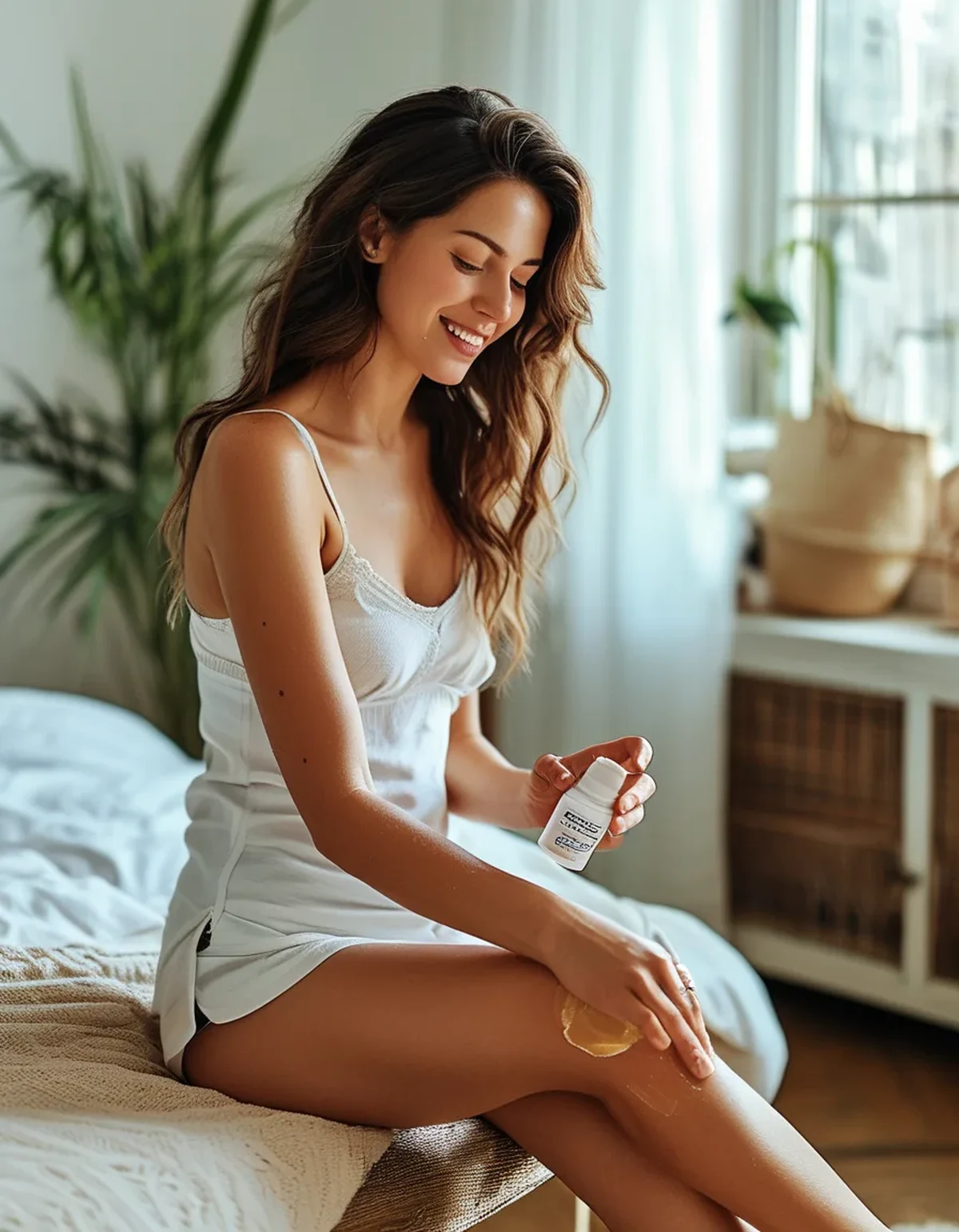
Barrier products — balms, sticks, silicone-based creams — work differently. They do not absorb anything. They put a low-friction layer between two surfaces, and most of them are water-resistant, so they keep working when wet. That is the property that matters in humidity.
Within barriers, there is a durability spectrum. Petroleum-based ointments last longest and are messiest. Silicone-containing balms — look for dimethicone or cyclomethicone on the label — feel dry to the touch and hold up well through sweat. Plain waxy sticks are the most convenient and typically need reapplying after a couple of hours in real humidity.
For what it is worth, the single most reliable solution is not a product at all: a fabric layer between the thighs.
What actually works, in order?
Shorts under the dress or skirt. Slip shorts, bike shorts, or thigh bands remove skin-to-skin contact entirely. This is the only intervention that addresses the cause rather than managing it. Look for a flat-hem or raw-cut leg opening, because a thick elastic band at the hem creates its own friction line. Length matters too — the hem needs to sit below where your thighs touch, not at it.
Balm before, not after. Apply before the walk, not after the burn starts. On a long day, reapply at the halfway point; that one habit prevents most of the bad outcomes.
Rinse and dry-change on multi-activity days. If you have already sweated through one activity, the salt is on your skin. A quick rinse and dry beats layering more product on top of grit.
Choose fabric over cut. Cotton holds water and stays wet against skin. Nylon or polyester blends move moisture, and moisture-moving is the whole game. A well-chosen synthetic short in a light color beats an expensive cotton one.
Check the seams. An inseam seam that sits exactly at the contact point will chafe even through good fabric. Flat-lock or seamless construction in that specific spot is worth paying for.
Treat existing chafe as a wound. Once skin is broken, keep it clean, apply a plain healing ointment, and give it a day of no friction if you can. Continuing to walk on raw skin with balm on top is how a two-day irritation becomes a week-long one. If it is weeping, spreading, or looks infected, see a professional — this is general information, not medical advice.
What Nobody Tells You About Chafing
It is not about size. Chafing is about contact plus moisture plus movement, which is why lean marathon runners get it badly and why it appears in the armpit, under the bust and along waistbands. Framing it as a body-shape problem sends people toward the wrong solutions.
Your stride matters more than your mileage. Walking on sand, up hills, or in flip-flops changes your gait and increases inner-thigh contact. A chafing episode after an unusual walking surface is common and often mistaken for a product failure.
Deodorant genuinely works as an emergency fix. Antiperspirant stick applied to the inner thigh reduces both sweat and friction. It is not the best long-term answer, but it is the one you already own.
New shorts chafe before they are broken in. Fabric softens and seams settle. If a pair chafed once, wash it a few times before writing it off.
The season ends before you think. As soon as overnight humidity drops in early fall, this problem largely resolves on its own — which is why people abandon a working routine in September and are surprised again the following July. Keep the balm in the bag.
FAQ: Chafing Questions, Answered
Do thigh bands actually stay up?
Silicone-gripped bands work well on some people and migrate on others, largely depending on where your widest point is relative to the band. Wider bands, three inches or more, stay put considerably better than narrow ones.
Is cornstarch better than talc?
Both absorb, and both become paste once saturated. Cornstarch-based powders are the more common formulation now. The saturation limit, not the ingredient, is what determines whether powder works for you.
Can I use a balm and shorts together?
Yes, and on a long humid day that is the most robust combination — the shorts prevent skin contact and the balm handles the short-hem-versus-thigh line. It is what most people who walk long distances in summer actually do.
Why does it sting so much in the shower?
Broken skin plus water plus soap. Rinse with plain cool water first, pat rather than rub, and let it dry fully before applying anything. The sting is not a sign of damage getting worse.
TL;DR:
- Chafing is friction on water-softened skin, so humidity — not temperature — is what makes late summer the worst stretch.
- Dried salt crystals are abrasive, which is why the second sweaty walk of the day is always worse.
- Powder fails at high sweat volumes because it becomes paste; silicone-based balms keep working when wet.
- The only fix that removes the cause is a fabric layer — shorts with a flat hem that sits below the contact point.
It is not your body and it is not the heat. It is a wet-skin problem, and it responds to dry-skin solutions.
Keep Reading
This article is for general informational and styling purposes only. Fit, sizing, and product availability may vary.
