Why Boots Are Harder to Buy Than Jeans When You Have Strong Legs
Quick Answer: Boot shafts are graded from foot size, so a size 8 boot assumes an average calf for a size 8 foot - and calf circumference varies far more between people than foot length does. Muscular calves sit well outside that assumption. Wide-calf ranges, stretch panels, and adjustable laces solve it, and measuring your calf at its widest point is the step that makes online shopping possible.
You know your jeans. You know which brands cut a thigh properly and which ones you can ignore.
Then you pick up a knee-high boot in your usual size, and it stops at mid-calf and will not go further, and there is nothing about the size label that predicted that.

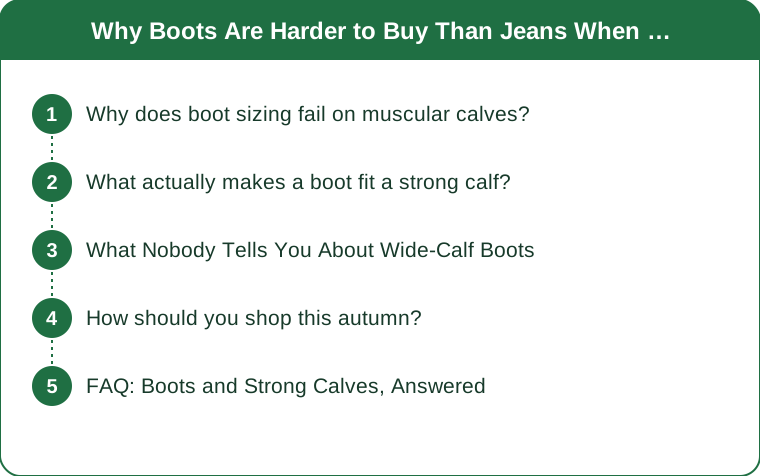
Why does boot sizing fail on muscular calves?
Because there is only one number on the box, and it is about your foot.
Boot shafts are graded from foot size. A manufacturer takes a base calf circumference for their sample size and scales it up and down with the shoe size. So a size 8 boot gets whatever calf width the pattern says a size 8 should have.
Foot length and calf circumference are only loosely related. Calf circumference across adult women spans a very wide range at any given shoe size, driven by muscle mass, body composition, and genetics. Squatting, cycling, running, and hiking all build calf muscle substantially, and none of them change your foot.
So an athlete with strong legs is asking a boot for a circumference the pattern never anticipated. The standard shaft on a knee-high boot is often around 14 to 15 inches, and a muscular calf can easily be 16 to 18.
The frustrating part is that the fit fails at the top rather than the bottom. The foot is fine, the ankle is fine, and the shaft stops. Going up a shoe size adds very little shaft circumference - typically a fraction of an inch per size - while making the foot too big, which is why the standard workaround does not work.
And there is a second variable nobody mentions: calf height. Where your widest point sits matters as much as how wide it is. A short calf with a high widest point fits differently from a long one, and this is why two people with identical measurements can have opposite experiences with the same boot.
What actually makes a boot fit a strong calf?
Four features, and you can identify all of them in a product photo.
A stated shaft circumference. Brands that publish this number are the ones worth shopping with, because it makes online buying possible. If a listing gives shaft height and circumference, you can decide in ten seconds.
A stretch panel. Elasticated gussets at the back or the sides typically add two to four inches of give. This is the most common and most effective solution, and quality varies - a proper wide elastic panel behaves very differently from a narrow decorative one.
Adjustable closure. Laces up the back, buckles, or a full-length zip with a gusset all let the shaft open. Lace-back boots are the most adjustable option there is and they are consistently underrated.
Soft, unlined leather or suede. These stretch and mould over a few wears in a way that stiff or heavily lined boots do not. A boot that is very slightly tight in soft leather will usually become right; one that is tight in stiff leather will not.
What to avoid: rigid unlined shafts with no closure, heavily structured riding-boot styles, and anything where the zip runs to the top with no gusset. Those are the styles that fail hardest.
And remember the sock. A boot fitted in a shop over bare legs in September becomes a different boot in January over wool socks and tights.

What Nobody Tells You About Wide-Calf Boots
Wide-calf ranges have improved enormously and are still poorly signposted. Many mainstream brands now offer them and bury them in filters. Learning which retailers have a proper wide-calf filter is worth an evening of research once.
A cobbler can add a stretch panel. Inserting an elastic gusset into an existing boot is a standard alteration, costs a modest amount, and rescues boots you already own. Cobblers can also stretch leather shafts a limited amount with a boot stretcher.
Ankle boots sidestep the problem entirely and are the most worn boot style for most people anyway. If knee-high shopping is exhausting, a great pair of ankle boots plus tall socks covers most of the same ground.
Measure over what you will wear. Take the measurement at the widest point of your calf, standing, over tights or a sock of the thickness you plan to use. Sitting or bare-legged measurements will mislead you by an inch or more.
And strong calves are worth more than boots. Calf muscle is associated with better running economy, better ankle stability, and lower injury risk in a range of sports. The boot industry’s sizing assumptions are the thing that is wrong here, and it is worth saying plainly because a lot of women internalise this as a body problem when it is a pattern-grading one.
How should you shop this autumn?
Measure once, filter properly, and buy early.
Take three measurements and save them in your phone: calf circumference at the widest point over a sock, calf height from the floor to that widest point, and your usual shoe size. These three make almost every listing assessable without trying anything on.
Shop retailers that publish shaft circumference. This narrows the field usefully and immediately, and it turns online shopping from a lottery into a decision.
Prioritise stretch panels and lace-backs. Filter for them where you can, and look for them in the photos where you cannot.
Buy in September and early October. Wide-calf ranges are produced in smaller quantities and clear early, exactly like tall ranges. By the time boot weather properly arrives, the sizes are broken.
Try on over your winter sock. Take one with you or wear one.
Budget for a cobbler. A stretch panel inserted into a boot you love is a modest cost and transforms what you can buy.
And do not size up the foot to fix the calf. It adds a fraction of an inch at the shaft and gives you a boot that slips at the heel, which causes blisters and ruins the walk. The calf is a shaft problem and needs a shaft solution.
FAQ: Boots and Strong Calves, Answered
How much will leather stretch over time?
Soft unlined leather and suede will give perhaps half an inch to an inch with wear, and a cobbler’s stretcher can add a little more. Lined, structured, or synthetic shafts stretch very little, so buy those to fit from day one.
Are extra-wide-calf ranges genuinely different or just marketing?
Genuinely different where a shaft circumference is published - the numbers vary meaningfully between standard, wide, and extra wide. Where no number is published, treat the label with caution and check the measurement before ordering.
What about over-the-knee boots?
Harder again, since they need to accommodate the calf and then stay up on the thigh. Look specifically for styles with full-length lacing or a drawstring at the top, which are the two features that make them workable on a muscular leg.
TL;DR:
- Boot shafts are graded from foot size, and calf circumference varies far more between people than foot length does.
- Sizing up the shoe adds almost nothing at the shaft and ruins the foot fit.
- Look for a published shaft circumference, stretch panels, lace-backs, and soft unlined leather.
- Measure your calf at its widest point over a winter sock, shop in September while size runs are complete, and use a cobbler for a stretch panel.
The boots are not too small. They were patterned on an assumption about what a calf attached to your foot size should measure, and strong legs were never in the sample.
Keep Reading
This article is for general informational and styling purposes only. Fit, sizing, and product availability may vary.
