Why Your Jeans Wear Through at the Inner Thigh First - and How to Slow It
Quick Answer: Inner-thigh wear is abrasion, not weak fabric. Every step rubs the same small area, and thin, high-stretch denim fails there first. Slow it by choosing denim with at least 11 oz weight and under about 2 percent elastane, washing inside out and cold at most every 10 wears, rotating between at least three pairs, and reinforcing the area before it holes rather than after. Fusible interfacing applied at the first sign of thinning roughly doubles the remaining life of a pair.
Here is what actually drives the wear and what genuinely slows it down.

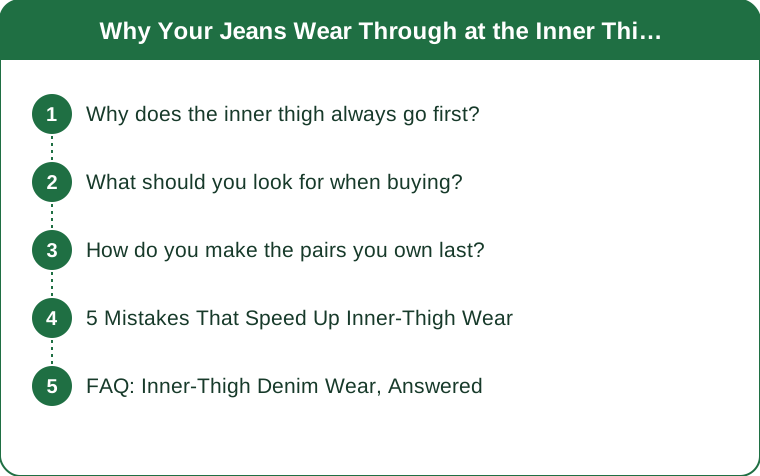
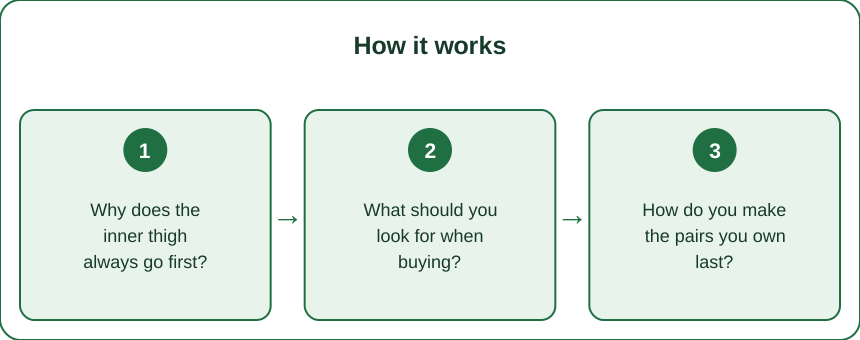
Why does the inner thigh always go first?
It is the only part of the garment rubbing against itself with every stride. Knees and seat wear through pressure and flex; the inner thigh wears through friction, which is a much faster process.
The step count is the part people underestimate. At 8,000 steps a day, that is roughly a quarter of a million abrasion cycles a season concentrated on an area the size of a postcard.
Stretch denim fails faster than rigid denim, and by a lot. Elastane fibres are finer and weaker than cotton, so a 3 percent elastane denim has meaningfully less abrasion resistance than a rigid one of the same weight.
Lightweight denim compounds it. Under about 10 oz, there is simply less material to lose before a hole appears. The same friction that thins a 13 oz jean punches through a 9 oz one.
Fit that is tight at the thigh increases contact pressure, and friction scales with pressure. A jean that is snug rather than tight at the widest part of the thigh wears noticeably slower.
Washing accelerates everything. Agitation is abrasion, and a hot wash with a tumble dry removes more fibre in an hour than a fortnight of wearing does.
What should you look for when buying?
Check the ounce weight and aim for 11 oz or heavier. Many brands publish it. Heavier denim is the single strongest predictor of how long a pair survives at the thigh.
Keep elastane at or below about 2 percent. You still get comfort and recovery, but not at the cost of halving the abrasion life. Look for denim that gets stretch from mechanical weave rather than only from elastane.
Look for a flat-felled or double-stitched inseam. A bulky seam becomes the high point that takes all the friction, and a flatter seam distributes it more evenly.
Try the sitting test in the fitting room. Sit, cross one leg, and stand. If the inner thigh pulls visibly tight when seated, the contact pressure in wear will be high.
Consider a slightly straighter leg. Skinny fits maximise thigh contact by design; a straight or relaxed straight reduces the pressure at the same body measurement.
Prefer a mid or high rise for thigh fit specifically. A higher rise allows a fuller thigh cut without gaping at the waist, which is precisely the trade that causes people to buy too-tight jeans.
And buy in threes where budget allows. Rotation is the most effective single intervention: three pairs worn in rotation last considerably more than three times as long as one worn constantly, because fibres recover between wears.

How do you make the pairs you own last?
Wash cold, inside out, and no more than every 10 wears. Each wash cycle is thousands of abrasion cycles concentrated in a machine drum. Spot clean between washes and air them overnight.
Never tumble dry. Heat degrades elastane and tumbling is pure mechanical abrasion. Line drying alone measurably extends the life of the inner thigh.
Reinforce at the first shine, not the first hole. Lightweight fusible interfacing ironed onto the inside of the thinning area is invisible from outside and roughly doubles the remaining wear.
Add a sacrificial layer for high-wear days. Seamless shorts or a slip short under jeans on a long walking day reduce skin-to-fabric friction and chafing at once.
Rotate deliberately, not randomly. Give a pair at least 48 hours between wears so the fibres and elastane recover their shape.
Repair early with a darning patch from the inside. Once the hole appears, the surrounding fabric is already weakened, and a patch on healthy fabric holds far better than one bridging a gap.
And keep one pair as the good pair. The simplest way to protect a jean you love is to stop wearing it for 8,000-step days and use a heavier rotation pair for those.
5 Mistakes That Speed Up Inner-Thigh Wear
1. Buying the tightest size that fastens. Contact pressure drives friction. A jean that is snug rather than tight at the thigh wears substantially slower at the same waist size.
2. Washing after every wear. Ten wears between cold washes is entirely reasonable for denim, and each wash you skip is thousands of abrasion cycles avoided.
3. Tumble drying. Heat degrades elastane, and the drum abrades the fabric. This one habit ages a pair faster than the walking does.
4. Waiting for the hole. By the time there is a hole, the fabric around it is already thin, so the repair sits on weak cloth. Reinforce at the first sign of shine.
5. Wearing one favourite pair constantly. No rotation means no recovery time. Three pairs in rotation outlast one pair by more than a factor of three - the maths genuinely works in your favour here.
The theme is that wear is cumulative and mostly invisible until it is not. Every intervention above is small; together they routinely double the life of a pair, which matters most for exactly the jeans that fit well and are hard to replace.
FAQ: Inner-Thigh Denim Wear, Answered
Why do my jeans always wear out at the inner thigh?
Because that is the only area rubbing against itself with every step - roughly a quarter of a million cycles a season. It is friction, not a manufacturing fault.
What denim weight lasts longest?
11 oz or heavier. Lightweight denim under about 10 oz simply has less material to lose before a hole appears.
Does stretch denim wear out faster?
Yes. Elastane fibres are finer and weaker than cotton, so keeping elastane at or below about 2 percent noticeably extends abrasion life.
How often should I wash jeans?
Every 10 wears or so, cold and inside out. Spot clean and air them in between - each wash is a concentrated dose of abrasion.
Can I reinforce jeans before they hole?
Yes, and this is the highest-value repair available. Iron lightweight fusible interfacing onto the inside at the first sign of shine; it is invisible from outside and roughly doubles remaining life.
Does rotating pairs really help?
Substantially. Fibres and elastane recover shape between wears, so three pairs in rotation last more than three times as long as one worn constantly.
Would a different cut help?
Yes. A straight or relaxed straight leg reduces thigh contact pressure compared with a skinny fit at the same body measurement, and a higher rise lets you buy a fuller thigh without waist gaping.
TL;DR:
- It is abrasion, not weak denim - a quarter of a million rubbing cycles a season on one small area.
- Buy 11 oz or heavier, with 2 percent elastane or less. Both predict lifespan better than price does.
- Snug beats tight. Contact pressure drives friction, so the widest part of the thigh should not pull when seated.
- Wash cold, inside out, every 10 wears. Never tumble dry.
- Rotate at least three pairs, with 48 hours between wears.
- Reinforce at the first shine with fusible interfacing - it roughly doubles remaining life and is invisible.
- A straighter leg and a higher rise both reduce thigh contact at the same measurement.
The pairs worth protecting are the ones that already fit. Every hour spent on the list above buys back a season.
Keep Reading
This article is for general informational and styling purposes only. Fit, sizing, and product availability may vary.
