Why Your Jeans Always Wear Out in the Same Spot
Quick Answer: Inner-thigh blowouts happen because that spot combines continuous friction, four layers of seam bulk, and repeated flexing — every step abrades the same square inch. The things that actually extend jeans’ life: choose denim with lower elastane content and a heavier weight, size for your thigh rather than your waist, wash less and inside out, and reinforce the area before it opens rather than after.
You spent real money on these. Four months later there is a thin patch at the inner thigh, and a month after that, a hole.
The location is not random and it is not about how you walk — it is the one point on a pair of jeans where friction, seam bulk, and repeated flexing all coincide. The third section covers the fabric spec that makes the biggest difference, and it is not the one on the front of the tag.

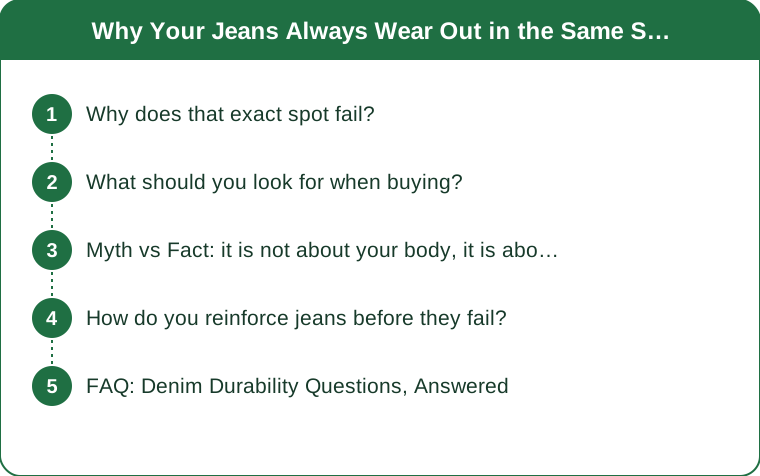
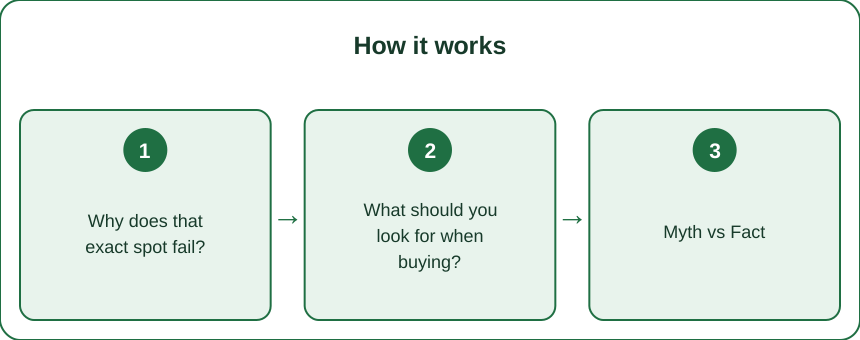
Why does that exact spot fail?
Three forces converging on a small area.
Friction, continuously. With every step, the inner thighs contact each other and the fabric abrades against itself. This happens thousands of times a day, and abrasion is cumulative. On a fuller thigh, the contact area is larger and the pressure through it is higher, so the abrasion rate is higher.
Seam bulk at the crotch junction. The inseams from both legs meet the crotch seam at a single point, creating a thick intersection of multiple fabric layers and stitching. That thickness is stiffer than the surrounding denim and it does not flex the same way, so it acts like a hard edge rubbing against softer fabric. The failures almost always start immediately adjacent to that junction rather than in the middle of the panel.
Repeated flexing. Sitting, standing, and walking all bend the fabric at the same place. Fibers under repeated flex fatigue and break independently of abrasion.
And modern denim is more vulnerable than it used to be. Stretch denim contains elastane, which is a much weaker fiber than cotton. As elastane content rises, the fabric gets more comfortable and less durable. Lower weight plus higher stretch equals faster failure, and that combination describes most of what is currently sold.
The classic sequence: the fabric thins and goes fuzzy, the weave opens, small holes appear, and then one day it opens up in a single motion — usually sitting down.
What should you look for when buying?
Two specifications, both usually listed, both usually ignored.
Fabric weight, in ounces. Denim weight is measured in ounces per square yard. Lightweight denim is roughly 10 oz and under, mid-weight around 11 to 13 oz, and heavyweight 14 oz and above. Heavier denim resists abrasion substantially better. If jeans blow out on you routinely, moving from a light stretchy denim to a mid or heavy weight is the single biggest change available.
Elastane content. Look for it in the composition. Around 1 to 2% elastane gives you comfort with reasonable durability. Above 3%, durability drops noticeably. Jeans marketed as super stretch or jegging-adjacent are often well above that.
Beyond the fabric:
Fit for your thigh, not your waist. Jeans that are tight through the thigh are under tension at exactly the failure point, and tension plus friction accelerates everything. A style cut with more room in the thigh — a straight leg, a relaxed or curvy fit, a mom jean — lasts dramatically longer than a skinny sized to fit your waist.
Check the crotch construction. Some brands reinforce the crotch junction with a gusset or extra stitching. It is not always advertised, but turning the jeans inside out in the fitting room shows you.
Consider rise. A higher rise positions the crotch junction differently and can move the seam intersection away from the highest-friction point.
Selvedge and rigid denim last far longer, at the cost of a break-in period and no stretch. Worth knowing as an option even if it is not your preference.

Myth vs Fact: it is not about your body, it is about the construction
Myth: Jeans wear out at the inner thigh because of thigh size, so there is nothing to be done about it.
Fact: Thigh contact is what puts friction in that location, but what determines how fast the fabric fails is the fabric and the fit — both of which you control.
The evidence for this is straightforward: the same person wearing heavier, less stretchy, better-fitting jeans gets dramatically more wear out of them. If body shape were the whole story, that would not be true.
Three specific construction factors are doing most of the damage in a typical modern pair:
High elastane in a light fabric. Marketed as comfort. It is a genuinely weaker textile, and it is now standard.
Skinny fits sized to the waist. This puts the fabric under tension at the thigh. Fabric under tension abrades faster and tears more readily once weakened.
No reinforcement at the seam junction. A detail that costs the manufacturer very little and is routinely omitted.
And the maintenance factor almost nobody knows: washing is a major cause of denim wear. Machine washing and especially tumble drying abrade fibers, and heat degrades elastane specifically. A pair washed after every wear will fail far sooner than the same pair washed every few wears.
The practical maintenance protocol:
Wash inside out, cold, on a gentle cycle, and only when actually needed. Spot-clean between washes.
Never tumble dry. Heat is what kills the stretch fiber. Hang dry.
Rotate pairs. Wearing the same jeans daily concentrates all the wear on one garment and gives the fibers no recovery time.
This is not about being precious with clothing. It is that denim is one of the few garments where care routine measurably changes lifespan.
How do you reinforce jeans before they fail?
The intervention is far easier before there is a hole, and this is where most people miss the window.
Watch for the thinning stage. Before a hole, the fabric goes pale, fuzzy, and slightly transparent when held to light. That is the moment to act. Reinforcing intact-but-thin fabric is simple; patching an open hole is a repair job that always shows.
Fusible interfacing on the inside. Iron-on interfacing or denim patches applied to the wrong side of the thinning area, cut generously so the edges land on healthy fabric. Invisible from outside, takes ten minutes, and buys many months.
Machine darning. Free-motion stitching back and forth over the thin area with matching thread. Adds material and strength while staying subtle. Many tailors will do this cheaply if you do not sew.
Sashiko-style visible mending. If you like the aesthetic, running stitch reinforcement in contrasting thread is durable, attractive, and increasingly common as a deliberate style rather than a repair.
A tailor can add a gusset. For jeans you genuinely love, a tailor can insert a small diamond of fabric at the crotch junction that both reinforces and reduces the seam bulk. It is not expensive relative to replacing good jeans.
Prevention while wearing: anti-chafe balm or thigh bands do reduce skin friction, which is comfort-related, and by reducing how much the fabric is dragged against itself they modestly help the fabric too.
A seasonal note: autumn is when jeans come back into heavy rotation after a summer of dresses and shorts, and it is worth checking the inner thighs of every pair you own now, while they are still at the thinning stage. Ten minutes with interfacing across three pairs is a much better use of an evening than replacing them in January.
FAQ: Denim Durability Questions, Answered
Are expensive jeans actually more durable?
Not automatically — plenty of expensive jeans use lightweight high-stretch denim. What correlates with durability is fabric weight and low elastane, and those specs appear at every price point. Read the composition rather than the price tag.
Does wearing tights or shorts under jeans help?
It reduces skin-to-fabric friction and can help with comfort, but the primary abrasion is fabric against fabric at the inner thigh, so the effect on the jeans themselves is modest. Fit and fabric weight matter far more.
How long should a pair of jeans reasonably last?
With mid-weight denim, a fit that is not tight at the thigh, and sensible washing, a couple of years of regular wear is a reasonable expectation. Lightweight high-stretch jeans worn frequently and machine dried may not make it through a single season, which is a construction issue rather than a user error.
TL;DR:
- The inner thigh fails because friction, seam bulk, and repeated flexing all meet at one point.
- Fabric weight and elastane content matter more than price — aim for mid or heavy weight and under 2% elastane.
- Fit for your thigh, not your waist; fabric under tension abrades faster.
- Wash inside out and cold, never tumble dry, and rotate pairs.
- Reinforce at the thinning stage with interfacing or darning, before there is a hole.
The genuinely useful reframe here is that this is a materials problem with known solutions, not something about your body that you have to accept. Turn over the last pair that failed you and read the composition on the care label — there is a good chance it says something like 2% elastane on a lightweight denim, and there is a good chance the next pair does not have to. Check your current jeans for thinning this week, and spend ten minutes with iron-on interfacing on any pair that has started. That is the whole intervention.
Keep Reading
This article is for general informational and styling purposes only. Fit, sizing, and product availability may vary.
