Why Your Tights Ladder at the Inner Thigh Every Time
Quick Answer: The inner thigh is where fabric-on-fabric friction is highest, where the knit is stretched most, and where seams from the gusset meet the leg. Abrasion at speed thins the yarn, and once a single filament breaks in a knitted structure the ladder runs. Higher denier, a proper gusset, cool hand washing and rotating pairs all extend life substantially, and a light anti-friction balm underneath does more than any of them.
It is a friction problem with a very predictable location.
We have covered inner thigh chafing in shorts, jeans inner seam blowout, and why fabric choice matters more than fit for chafing. This is the tights version.

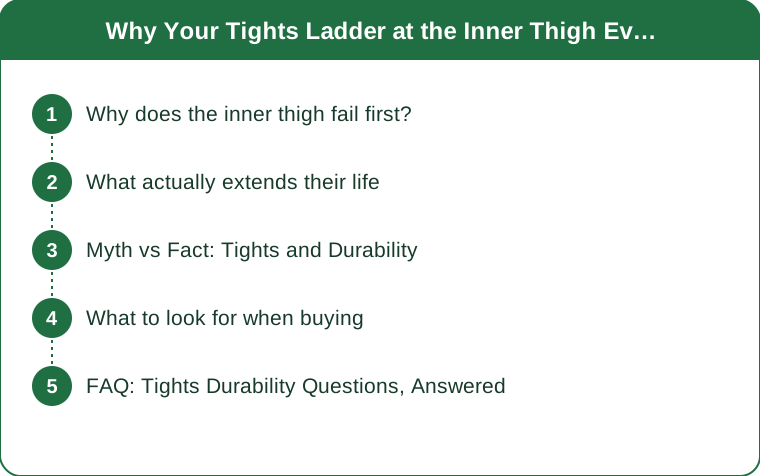
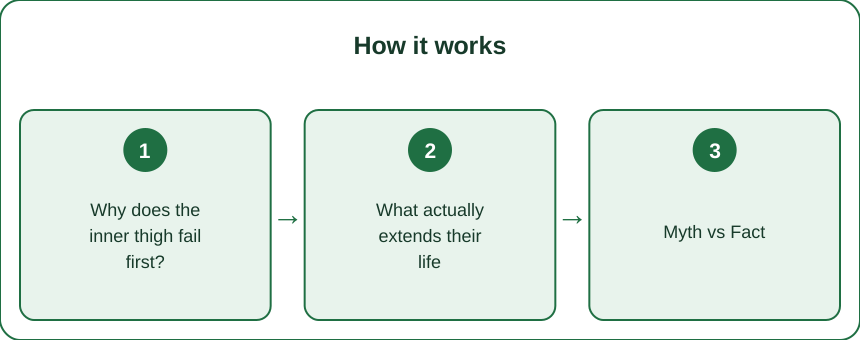
Why does the inner thigh fail first?
Three loads overlap in the same small area, and no other part of the garment sees all three.
Fabric rubs against fabric with every step. Nowhere else on a pair of tights experiences continuous same-on-same abrasion at walking speed.
The knit is stretched most there. Circumference at the upper thigh is the widest point the tube has to accommodate, and stretched yarn is thinner yarn.
Heat and moisture concentrate in the same place, which softens fibres and increases the friction coefficient further.
Knitted structures ladder from a single break. Tights are a continuous loop structure, so one broken filament releases the loops above and below it, and the run travels.
Nylon abrades faster when warm. Body heat plus friction heat is enough to soften the fibre measurably, which is why the failure accelerates in warm weather and under trousers.
And seams add a hard edge. Where a gusset seam meets the leg, a slightly stiffer line rubs against soft knit, and that boundary is a very common starting point.
What actually extends their life
Six changes, roughly in order of effect.
Anti-friction balm on the inner thighs before dressing. This is the single most effective thing available, it costs very little, and it addresses the actual mechanism rather than the symptom.
Choose tights with a proper cotton gusset. A gusset moves the seam away from the highest-friction zone and adds a more abrasion-resistant panel where it is needed.
Go up in denier for everyday wear. Anything at 40 denier and above has substantially more yarn in the structure and lasts several times longer than sheer 15 denier.
Size up rather than down. Less stretch means thicker yarn at the point of contact, and a size up frequently doubles the life of a pair.
Hand wash cool and air dry. Machine agitation and heat both accelerate exactly the fibre degradation causing the problem.
And rotate pairs. Elastane needs roughly a day to recover, and tights worn on consecutive days start each wear from a partly stretched state.
One habit worth building: put tights on sitting down, gathered from the toe up, rather than standing and pulling. Most first-wear damage happens during dressing, not during wear.

Myth vs Fact: Tights and Durability
Myth: Expensive tights last longer. Fact: Denier and construction predict lifespan far better than price. A well-made 60 denier pair at a modest price outlasts a sheer designer pair by a wide margin.
Myth: Freezing tights makes them stronger. Fact: This is a persistent internet claim with no mechanism behind it. It does nothing to nylon fibre strength.
Myth: Clear nail varnish stops a ladder. Fact: It does stop a run from spreading, which is genuinely useful in the moment. It does not repair the break and the varnish becomes a stiff spot that often causes the next failure nearby.
Myth: Laddering means you bought a bad pair. Fact: It usually means friction, and friction is a function of your stride, your thigh contact and the denier — not of manufacturing quality.
Myth: Sheer tights and opaque tights wear the same way. Fact: Sheer tights have far less yarn to abrade through, so the same friction produces failure much faster. If you need durability, denier is the lever.
Myth: A gusset is just for comfort. Fact: It moves seams away from the highest-friction area and adds a more robust panel there. It is a durability feature that happens to also be more comfortable.
What to look for when buying
Six specifics that separate a pair that lasts from one that does not.
Denier of 40 or above for everyday wear, and 60 to 80 for anything you want to last a season.
A cotton gusset, stated in the product description. Its absence is a reliable predictor of early inner-thigh failure.
Flat or seamless construction at the top, which reduces the hard edges that start the abrasion.
A stated elastane content of at least eight percent, which gives the recovery that keeps the yarn from staying stretched.
Reinforced panels if you can find them. Some brands add a denser knit at the upper thigh specifically, and it works.
And your correct size by both height and hip. Most tights size charts use both, and most people use only one. The hip measurement is the one that determines thigh stretch.
Worth knowing: if a brand and size works, buy several pairs at once. Tights sizing varies enough between brands that finding a repeat is worth more than finding a bargain.
FAQ: Tights Durability Questions, Answered
Why do my tights always ladder at the inner thigh?
Because that is where fabric rubs against fabric at every step, where the knit is stretched most, and where gusset seams meet the leg. Abrasion thins the yarn until one filament breaks, and a knitted structure ladders from a single break.
Does anti-friction balm actually help tights last longer?
Yes, more than any other single change. It reduces the fabric-on-fabric friction that causes the abrasion, which addresses the mechanism rather than the symptom. A small amount on the inner thighs before dressing is enough.
Should I size up in tights?
Usually. Less stretch means thicker yarn at the contact point and less strain on the knit. Size by your hip measurement rather than by height alone, since hip is what determines how far the upper thigh is stretched.
TL;DR:
- The inner thigh is the only area with continuous fabric-on-fabric friction, maximum stretch and a seam boundary.
- Anti-friction balm before dressing is the highest-return fix, and it costs almost nothing.
- Denier and a cotton gusset predict lifespan far better than price does.
- Size up, wash cool, air dry, and rotate pairs. Elastane needs a day to recover.
It is not bad luck or bad tights. It is abrasion in a predictable place, and abrasion is manageable.
Keep Reading
This article is for general informational and styling purposes only. Fit, sizing, and product availability may vary.
