Why Work Pants Gap at the Waist the Moment You Sit Down
Quick Answer: Pants fitted primarily around a standing waist and hip measurement can gap open at the back waistband when seated, because sitting redistributes hip and thigh volume in a way standing measurements don’t account for — a slightly higher rise and stretch fabric closes that gap.
They looked perfect in the fitting room mirror. Then you sat down at your desk and felt that telltale draft at the small of your back where the waistband pulled away from your skin.

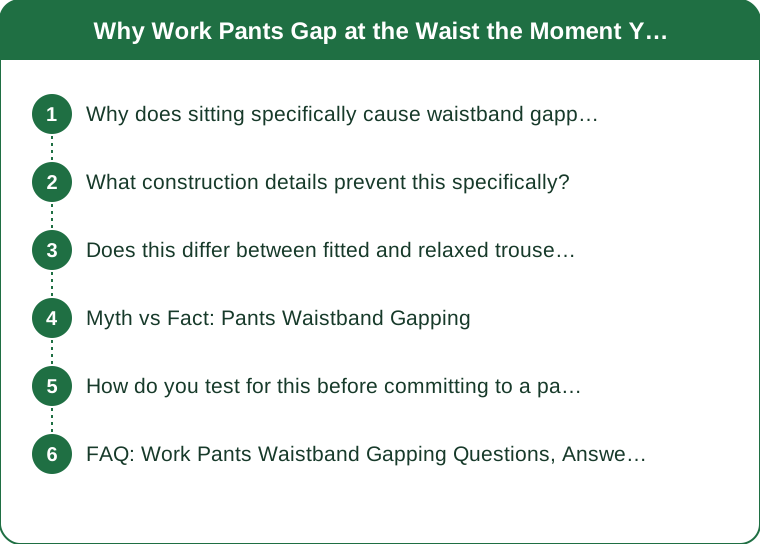
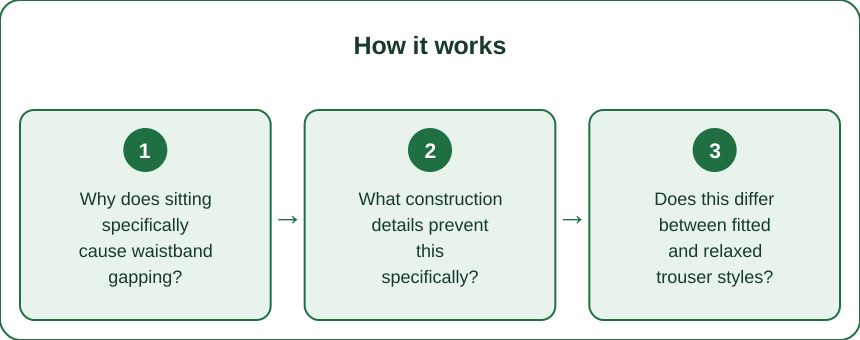
Why does sitting specifically cause waistband gapping?
When you sit, your hips and thighs widen slightly and the pelvis tilts, which changes the body’s actual circumference at waist level compared to standing. A pant fitted to a standing measurement — which is how most in-store fittings and size charts are calibrated — doesn’t have the built-in ease to accommodate that seated shift, so the back waistband is pulled outward and away from the body.
This effect is more pronounced for body shapes with more volume through the hip and thigh, since the seated redistribution has more tissue to accommodate, requiring more waistband ease to stay put through the position change.
What construction details prevent this specifically?
A slightly higher back rise (even half an inch higher than the front) gives more coverage margin for the seated pelvic tilt, since it’s specifically the back waistband that tends to gap, not the front. Some better-constructed trousers include this asymmetric rise detail exactly for this reason, even though it’s rarely called out explicitly in product descriptions.
Stretch fabric blends (with at least 2-4% spandex or elastane) also help significantly, since the waistband can flex with the seated shift rather than staying rigid and pulling away. A 100% rigid cotton or wool trouser is far more prone to this gapping than a blend with even a small percentage of stretch.
Does this differ between fitted and relaxed trouser styles?
Fitted, tailored trousers gap more noticeably because they’re cut with less overall ease to begin with, so there’s less slack to absorb the seated shift before the waistband visibly pulls. Relaxed or wide-leg styles tend to have more built-in ease throughout, which incidentally also provides more seated comfort margin at the waist, even though that’s not usually the stated reason for choosing a relaxed fit.
This is a useful thing to know when choosing trouser style for a job that involves a lot of sitting versus one that’s more standing and moving — the ‘fit’ that looks best standing in a mirror isn’t always the one that performs best through a full seated workday.
Myth vs Fact: Pants Waistband Gapping
Myth: Waistband gapping means you bought the wrong size. Fact: it’s often a rise and fabric construction issue rather than an overall size issue — sizing up can actually make the gap worse by adding excess fabric elsewhere without fixing the seated fit.
Myth: A belt fixes waistband gapping. Fact: a belt can pull the waistband tighter, but if the underlying rise is too short for a seated position, the belt just relocates the gap rather than eliminating it, and can create new pulling or bunching elsewhere.
Myth: This only happens with cheap or poorly made pants. Fact: even well-constructed trousers gap if they weren’t specifically designed with a seated fit test — it’s a design choice, not purely a quality issue.
How do you test for this before committing to a pair?
Sitting down in the fitting room, not just standing in front of the mirror, is the single most reliable test — many stores have a bench or chair specifically for this reason, and it’s worth using it even if it feels like an extra step. Checking the back waistband with a hand while seated reveals gapping that’s completely invisible while standing.
If shopping online without a fitting room, checking reviews specifically mentioning ‘sitting’ or ‘desk job’ fit gives a more reliable read than standard size reviews, since this issue is specific enough that people who’ve experienced it tend to mention it directly.
FAQ: Work Pants Waistband Gapping Questions, Answered
Can a tailor fix a gapping waistband after purchase?
Yes, to a degree — a tailor can take in the back waistband slightly, though this works best on pants with some seam allowance and doesn’t fully replicate a properly designed asymmetric rise.
Does this affect jeans the same way as work trousers?
Yes, though stretch denim blends have become common enough that many jeans already include the stretch fix even if not marketed specifically for sitting comfort.
Is high-waisted always better for avoiding this issue?
Generally yes, since a higher rise gives more overall coverage margin through the seated shift, though the back-specific rise height matters more than just overall waist height.
TL;DR:
- Sitting redistributes hip and thigh volume in a way standing-based sizing doesn’t account for
- A higher back rise and stretch fabric blend both directly reduce waistband gapping when seated
- Fitted, low-ease trousers gap more than relaxed styles — worth factoring in for desk-heavy jobs
- Test-sit in the fitting room and check reviews mentioning desk or sitting fit before buying online
That draft at your lower back isn’t a sizing mistake — it’s a seated-fit gap that better rise and fabric construction solve directly, no belt required.
Keep Reading
This article is for general informational and styling purposes only. Fit, sizing, and product availability may vary.