Why Chafing Starts at a Specific Humidity, Not a Specific Distance
Quick Answer: Skin friction is lowest when skin is dry and highest when skin is damp — a thin film of moisture dramatically increases the coefficient of friction between two surfaces, while fully wet skin reduces it again. Humid weather holds skin in exactly the damp middle range for hours, which is why chafing appears at distances and durations that caused no problem in drier conditions. It is a moisture threshold rather than a mileage one.
Manage the moisture and the distance stops mattering.

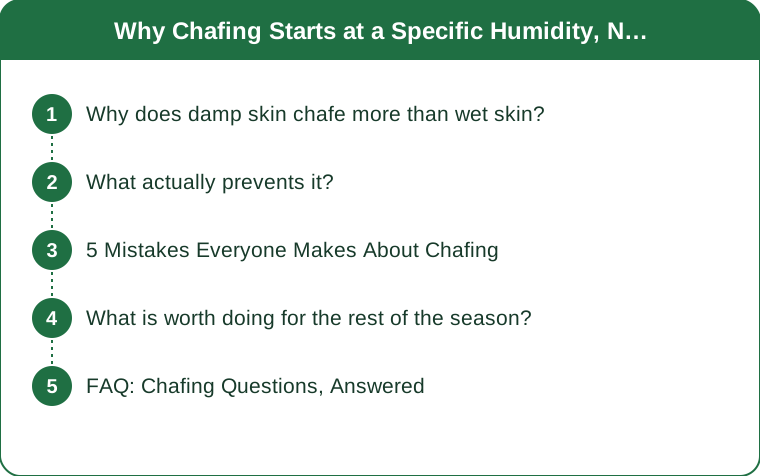
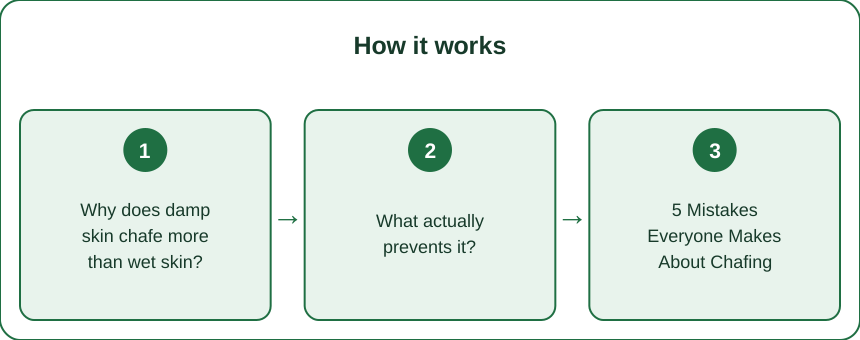
Why does damp skin chafe more than wet skin?
Because friction between soft surfaces peaks at intermediate moisture, not at maximum moisture.
Skin friction is not constant. Dry skin against dry fabric has relatively low friction. Add a small amount of moisture and friction rises sharply, because the water forms capillary bridges between the surfaces that resist sliding. Add a lot more water and friction falls again, as the film becomes thick enough to act as a lubricant.
The practical consequence: the worst condition is slightly damp, and humid weather holds you there indefinitely.
Why humidity in particular:
Sweat cannot evaporate in humid air, so it accumulates on the skin. In dry air, the same sweat rate produces skin that is briefly damp and then dry again.
Inner thigh skin is the specific problem area because it is enclosed, contacts itself or fabric continuously, has limited airflow, and is one of the last places to dry.
Sweat also leaves salt behind. As water evaporates from sweat, sodium chloride crystals remain, and salt crystals are abrasive. Repeated rubbing against salt residue damages the skin surface directly, which is why chafing is worse late in a long hot outing than early.
Heat causes mild swelling. Vasodilation in heat increases limb volume slightly, which increases contact area and pressure between surfaces.
Damaged skin chafes faster the next time. Once the outer barrier is compromised, the threshold for irritation drops, which is why a bad chafe in August tends to recur for the rest of the season.
What actually prevents it?
A barrier, a fabric layer, or both. Powders are the weakest option.
Anti-chafe balms and sticks are the primary tool. They create a low-friction layer that stays put in the presence of moisture. Apply before you go out, not after you feel it, and reapply on long outings.
Fitted shorts underneath are the most reliable prevention. A slip short, bike short, or fitted under-layer eliminates skin-on-skin contact entirely. Fabric against fabric has much lower friction than damp skin against damp skin.
Fabric choice matters within that. Smooth synthetic knits with good moisture-wicking outperform cotton by a wide margin, because cotton holds moisture against the skin and stays in the damp danger zone. Seamless construction matters — a flat seam in the wrong place creates a pressure point that chafes worse than bare skin.
Length matters too. The under-layer needs to extend past the point where your thighs actually contact, which for most people is further down than they assume. A short that ends exactly at the contact point creates an edge that rubs, which is worse than no layer at all.
Powders are the weakest option. They absorb moisture and then clump into a gritty paste that increases abrasion. They work for light, short exposures and fail on long humid days.
Deodorant is a genuine improvisation that works reasonably well, since antiperspirant reduces local sweating and the stick base provides a mild barrier.
Address the moisture at the source where you can. Loose outer layers, breathable fabrics, and taking a break in the shade to let skin dry all reduce the total exposure time.
And after the fact: clean gently, dry thoroughly, and use a barrier ointment. Broken skin needs to be kept clean and covered, and continuing to walk on it without protection is how a chafe becomes an infection.

5 Mistakes Everyone Makes About Chafing
1. Treating it as a size issue. Chafing happens to bodies of every size, and it depends on contact, moisture, and duration. Athletes across the whole range of body types deal with it, and framing it as a personal failing prevents people from using the simple solutions.
2. Using cotton under-layers. Cotton absorbs and holds moisture against the skin, keeping you in the worst friction range for hours. A wicking synthetic does the opposite.
3. Applying the balm after the walk starts. Prevention only works applied to clean dry skin before the exposure. Applying to already-irritated skin stings and works poorly.
4. Choosing an under-layer that is too short. The hem must sit below the contact zone, otherwise its edge becomes the new friction point. Check where your thighs actually touch when walking, not standing.
5. Relying on powder for a long humid day. Powder works for a couple of hours in moderate conditions and turns into an abrasive paste on a sweaty August afternoon.
What is worth doing for the rest of the season?
Late August is peak chafing weather, and the transition brings a different set of problems.
Right now, humidity is the dominant factor across much of the country. Dew point is a better predictor than temperature — a 26°C day with a high dew point produces more chafing than a dry 33°C day, and it is the reason people are surprised by the days that catch them out.
Prepare for the days you have not planned for. Chafing rarely happens on a planned long walk, where you have prepared. It happens on the unplanned errand, the long day in a city, the wedding, the festival — situations where you are on your feet for hours in humid air in clothing chosen for how it looks.
Keep a stick in your bag through September. Humid days continue well past the point where people stop thinking about it.
Into autumn, the mechanism changes. Cooler weather brings tights, jeans, and layered fabrics. Denim inner seams against damp skin are their own version of the problem, and tights that ladder at the inner thigh are the fabric-side symptom of the same friction.
Autumn also brings drier skin, and dry, compromised skin has a lower irritation threshold. Moisturising the area regularly through the drier months genuinely reduces chafing, which sounds counterintuitive given moisture is the trigger — the difference is skin barrier health versus surface wetness.
Buy the under-layers now. Slip shorts and bike shorts are on clearance in late August, and they are exactly what you want under autumn dresses and skirts.
This is general guidance rather than medical advice. Skin that stays broken, becomes increasingly red, hot, painful, or starts to weep may be infected and needs a doctor rather than more balm.
FAQ: Chafing Questions, Answered
Why did I chafe on a short walk when I am fine on long ones?
Because moisture matters more than distance. A short walk in humid air with damp skin can cross the threshold that a longer walk in dry conditions never reaches.
Do anti-chafe balms actually work?
Yes, and applied before the exposure to clean dry skin. Applying after irritation has begun is far less effective and usually uncomfortable.
Are powders any good?
For short, moderate exposures. In sustained humidity they absorb sweat, clump, and become abrasive, which makes the problem worse rather than better.
How long should the under-layer be?
Long enough that its hem sits below where your thighs actually contact during walking. A hem that lands exactly at the contact zone becomes the friction point itself.
TL;DR:
- Friction peaks when skin is damp rather than wet, and humid air holds skin in that range for hours.
- Salt residue from evaporated sweat is abrasive, which is why long hot days get progressively worse.
- A balm applied before exposure and a wicking fitted under-layer that extends past the contact zone solve it.
- Powders fail in sustained humidity, and cotton under-layers make it worse.
Put an anti-chafe stick in your bag today. The day it saves will be one you did not plan for.
See It in Motion
Seen here: Super High Waist Embossed Yoga Leggings with Inner Pocket — shop it on bubblelime.com
Keep Reading
This article is for general informational and styling purposes only. Fit, sizing, and product availability may vary.
