Why Shorts Ride Up Between Your Thighs and the Three Details That Stop It
Quick Answer: Shorts ride up because walking cyclically changes each thigh’s shape and the distance the fabric spans — every stride momentarily widens the thigh and shortens the fabric path, and a hem under tension resolves that cycle by creeping toward the widest point and staying there. Thighs that touch add a second engine: leg-to-leg contact drags inner fabric upward with each step. The three details that stop it are inseam length that clears your contact zone, a leg opening with genuine room, and construction — gusset, flat seams, grippers or weighted hems — that anchors the fabric path. Size changes none of those; details do.
Here is the mechanism, the three details in buying order, and the fitting-room tests that predict a whole day.


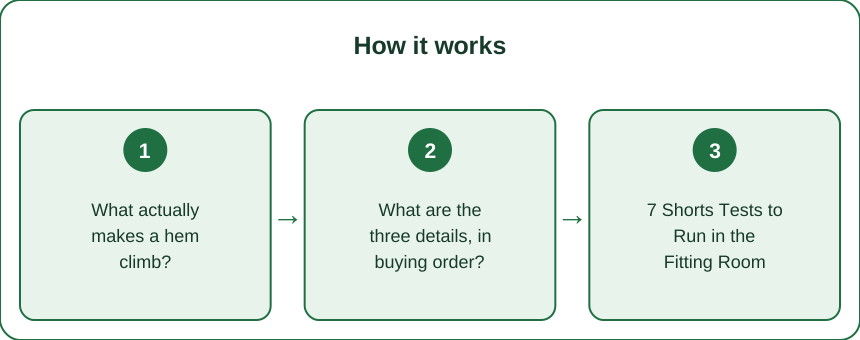
What actually makes a hem climb?
A ratchet built out of ordinary walking.
Each stride reshapes the thigh under the fabric. As the leg swings and the muscle works, thigh circumference at any given height changes moment to moment, and hip flexion shortens the front path the fabric must cover. Fabric under tension responds to every cycle by shifting toward the configuration with least stretch — which on a tapering thigh means upward, toward the wider zone where the fabric can sit less stretched. Each step is a small click of the ratchet; the hem never clicks back down on its own.
Touching thighs add the drag engine. Where inner thighs meet, skin and fabric move in opposite directions with each stride, and friction hands the inner hem an upward tug per step. This is why the climb concentrates at the inner leg first — the outer hem often stays put while the inner face gathers.
Heat and humidity tune the machine. Damp skin grips fabric harder, raising the per-step drag, which is why the same shorts behave in May and misbehave through a humid late-August afternoon. Slicker, drier interfaces climb slower — the logic behind both anti-chafe balm and better fabric choices.
And too tight is a climbing accelerant, not a fix. A leg opening gripping hard at the hem stores more elastic tension, and stored tension is exactly what powers the ratchet. The instinct to size down for security produces the fastest climb of all — the mechanism explains what the fitting-room mirror cannot.
What are the three details, in buying order?
Inseam, opening, construction — checked in that sequence, because each depends on the last.
Detail one: an inseam that clears your contact zone. Find where your thighs actually touch — for most people a span starting a few inches below the crotch — and choose an inseam that ends below it. A hem that terminates inside the contact zone sits in the drag engine; a hem below it never enters. For most thicker-thighed builds that means five inches as a floor for casual shorts and seven-to-eight-inch bike shorts for training. The two-inch running short is not a moral failing; it is a hem parked in the machine.
Detail two: a leg opening with genuine room. Two fingers should slide under the hem flat, without the fabric biting. Room at the opening lowers stored tension — draining the ratchet’s power supply — and paradoxically stays down far better than the gripping hem. In sizing terms: choose the size for the widest thigh point and let the waist be adjusted, never the reverse.
Detail three: construction that anchors the path. A diamond gusset at the crotch lets the fabric articulate without dragging the legs upward; flat or bonded inner seams halve the friction interface; silicone grippers hold impressively on firm-muscled legs but can dig and roll on softer thighs — test rather than assume; and slightly heavier, structured knits resist bunching where whisper-thin buttery-soft fabrics fold and climb. Longer bike shorts in a firm compressive knit are the category’s proof: all three details in one garment, which is why they became the default under-dress and errand short for anyone whose thighs meet.
Price buys logos; these three details buy the staying put. Check them in order and the rack sorts itself in five minutes.
7 Shorts Tests to Run in the Fitting Room
1. The twenty-step walk. Normal pace, phone away, then check the inner hem. Ten seconds of honest walking beats ten minutes of mirror posing — the climb needs strides to show itself.
2. The stair or step-up test. Two or three high knee lifts onto the fitting-room bench. Hip flexion is the ratchet’s biggest click; a hem that survives step-ups survives errands.
3. The chair sit-and-stand, twice. Sitting drives the hem to its highest position; standing reveals whether it recovers or stays parked. Shorts that need a tug after every chair fail this one in private later.
4. The two-finger hem check. Fingers flat under each leg opening: easy slide, no bite, no skin bulging over the edge. Bite at minute one is a climb by mile one.
5. The cross-legged sit. Floor or bench, legs crossed: checks the gusset and rise together. Pulling at the crotch seam or a waistband dragging down in back means the articulation the walk requires is not there.
6. The mirror-behind check. Walk away from the mirror and glance back: the rear hem should sit level, not migrating into the under-curve of the seat. Rear climb and inner climb are cousins; both show in the walking view, never the standing one.
7. The friction audit. Run a hand along the inner seam: flat, smooth, no ridge. Then the label: leg-opening grippers noted, gusset present, fabric weight substantial rather than tissue-thin. Sizes vary meaninglessly between brands — a five-inch inseam with a roomy opening in one brand fits like a three-inch gripper in another, which is precisely why the tests outrank the tag.
What about the days shorts are not the answer?
A staying-put system has more than one garment in it.
Under dresses and skirts, the longer bike short is the standing answer. Seven-to-eight-inch bike shorts in a firm knit turn every sundress into a walkable garment through the last hot weeks — the detail trio built into an invisible layer. A dedicated under-dress pair in a neutral, kept in rotation, retires the mid-walk hem negotiation entirely.
Skorts split the difference in public. The built-in short handles the contact zone while the skirt face handles the occasion; for errands, pickleball, and travel days they are the lowest-effort version of the whole solution.
Anti-chafe balm is the friction patch, not the fix. On the highest-humidity days, a swipe along the contact zone drops the per-step drag dramatically — worth its bag space every August — but it manages the engine rather than removing the hem from it. Pair it with the right inseam rather than instead of one.
Capris and cropped leggings own the shoulder-season weeks. As late August mornings cool, a light cropped legging does everything the long bike short does with more coverage, and the climb problem disappears entirely below the knee.
And buy the next size of the season now. End-of-summer clearance is when the seven-inch bike shorts and quality five-inch inseams go on sale; stocking the pair that passed all seven tests — in the next colour, or the next size if your training block is changing your legs — costs least in exactly these weeks. The staying-put wardrobe is built in August sales, not July emergencies.
The hem was never a verdict on your thighs. It was a construction question, and construction questions have shopping answers.
FAQ: Ride-Up Questions, Answered
Why do my shorts only ride up on one leg?
Bodies are asymmetric — one thigh is usually slightly fuller, and stride mechanics differ side to side, so one hem meets more drag and tension. If one leg climbs first every time, prioritise the fuller thigh’s measurements when sizing and favour designs with grippers or longer inseams that give the busier side margin.
Do silicone grippers work or just dig in?
Both, depending on your legs: on firmer muscle they anchor beautifully; on softer thighs they can dig, roll the hem, and leave marks — sometimes climbing anyway with the gripper folded inside. Test with the twenty-step walk and the two-finger check; if the gripper bites standing still, it loses to a roomy plain hem moving.
Is the ride-up worse because of my size?
Ride-up happens wherever thighs touch, across sizes — it is a contact-zone and construction issue, not a size verdict. The same three details fix it at every size: inseam past the contact zone, room at the opening, and friction-managing construction.
Are buttery-soft fabrics bad for shorts?
Not bad — mismatched to the job. Ultra-soft thin knits excel in leggings and lounge pieces, but at a short’s hem they fold, bunch, and ride sooner than structured knits. Keep buttery-soft for full-length days and give the shorts rotation to firmer, slightly heavier fabric; your hems will explain why.
TL;DR:
- Ride-up is a ratchet: each stride reshapes the thigh and shortens the fabric path, the hem creeps toward the widest point, and touching thighs add per-step drag — humidity accelerates all of it.
- Buy in order: inseam that ends below your contact zone, leg opening with two-finger room, then construction — gusset, flat seams, tested grippers, structured knits.
- Run the seven tests — walk, step-ups, sit-stand, hem check, cross-legged, mirror-behind, friction audit — and let them outrank the size tag every time.
- Longer bike shorts under dresses, skorts for occasions, balm for peak humidity, capris for cooling mornings, and August clearance to stock what passed.
Take the twenty-step walk on the next pair before buying. Ten honest seconds in the fitting room saves a season of tugging at hems.
See It in Motion
Seen here: High Waist Embossed Yoga Leggings with Side Pockets — shop it on bubblelime.com
Keep Reading
This article is for general informational and styling purposes only. Fit, sizing, and product availability may vary.
