Why Your Jeans Fit Standing and Cut Into You Sitting Down
Quick Answer: Thigh circumference increases roughly 1 to 2 inches when you sit, because muscle and soft tissue compress and spread against the seat. Standing-only fitting means denim that fits perfectly upright can be genuinely too tight seated. Look for at least 2 percent elastane and a mid-to-high rise with a curved waistband.
You tried them on. You walked around the fitting room. They were perfect.
Then you sat down in the car and the thigh seam introduced itself to your leg with real conviction.
That is not sizing error. It is a measurement taken in the wrong position.

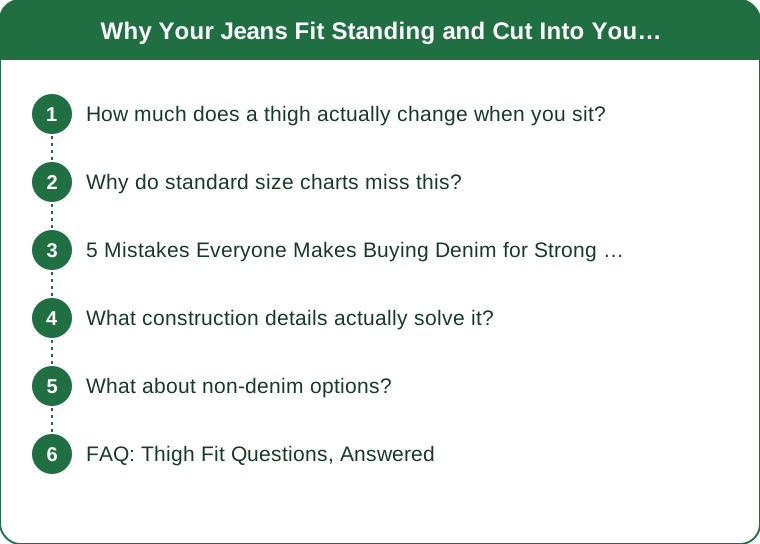
How much does a thigh actually change when you sit?
More than most size charts acknowledge. When you sit, the thigh flattens against the seat and spreads laterally — the same volume of tissue redistributes into a wider, flatter cross-section, increasing the circumference the fabric has to travel around.
The change is typically 1 to 2 inches and can be larger for muscular thighs, because muscle compresses less readily than fat and pushes outward instead.
There is a second effect at the same time: hip flexion at 90 degrees requires additional fabric length across the front of the thigh and across the seat. Denim that has no give in either direction has to get that length from somewhere, and it takes it by riding up and pulling tight.
So you are asking the garment for more circumference and more length simultaneously, at the exact moment it has the least slack available.
Why do standard size charts miss this?
Because industry fit standards are built around a standing fit model. Measurements are taken upright, and grading rules extend from that single posture.
The consequence for athletic or curvier legs is systematic. A brand’s thigh measurement at each size is derived from a fixed ratio to the hip measurement. If your thigh is larger relative to your hip than the fit model’s — which is common for anyone who lifts, runs, cycles, or is simply built that way — then every size will be proportionally tight in the thigh even when the hip fits.
That is the real explanation behind sizing up until the waist gapes. You are not buying a bigger size for your thighs; you are buying a bigger everything to obtain a specific thigh measurement, and paying for it at the waist.
What you actually need is a different thigh-to-hip ratio in the pattern, which some brands cut and most do not.
5 Mistakes Everyone Makes Buying Denim for Strong Thighs
1. Trying jeans on only standing. Sit down in the fitting room. Cross one leg. Squat slightly. If the thigh seam bites in any of those, it will bite all day.
2. Assuming stretch means comfort. Stretch percentage matters, but so does recovery — the fabric’s ability to return to shape. A 2 percent elastane denim with good recovery outperforms a 4 percent one that bags out by noon.
3. Buying rigid denim in the right size. 100 percent cotton denim will soften and stretch about half a size with wear, but it does not gain the vertical give that sitting requires. If you love rigid denim, buy the thigh slightly generous and accept a taken-in waist.
4. Focusing on the waist number. The waist is the easiest thing to alter — $15 to $25 at any tailor. The thigh is nearly impossible to let out. Buy for the thigh and alter the waist, always.
5. Ignoring rise. A low rise puts the tightest part of the garment across the widest part of your seated thigh. A mid-to-high rise moves the tension up to your waist, where there is more structural room.

What construction details actually solve it?
There are specific, checkable features that make denim work on a strong thigh.
2 to 3 percent elastane with good recovery. Read the composition tag. Look for a blend that includes elastane rather than only polyester, and prefer brands that mention recovery or shape retention.
Mid or high rise, 10 inches or more. Higher rise means the thigh seam sits in a less loaded position when you sit.
A curved or contoured waistband. This is what lets you buy for the thigh without the waist gaping. It is the single most useful feature for a high hip-to-waist ratio.
Straight, wide, or barrel legs over skinny. Volume below the knee balances the silhouette visually and — more practically — removes the tension entirely from the calf and knee, which changes how the whole leg feels.
Diagonal or curved yoke seams at the back. They add room over the seat, which relieves the pull that translates down into the thigh.
Avoid heavy distressing at the thigh. Shredded or thinned areas at the point of maximum tension are exactly where denim fails, usually within a few months.
What about non-denim options?
Denim gets the attention, but the same problem appears across every fitted bottom, and some categories solve it much better.
Ponte and heavy jersey trousers have four-way stretch and hold structure, so they read as tailored while behaving like knitwear. For anyone with strong thighs and a smaller waist, they are frequently the most comfortable workwear option available.
Wide-leg and trouser-cut pants in woven fabric skip the issue almost entirely, because the leg volume means the thigh is never the constraining measurement.
Chafing is the related problem worth naming. Where thighs touch, seams and dry friction cause real irritation. Flat-felled inner seams, a 5 to 7 inch short length that stays put, and an anti-chafe balm are the practical answers — this is a mechanical issue, not a fitness one, and it affects people at every size.
For activewear specifically, look for gussets — a diamond-shaped panel at the crotch. It adds fabric exactly where sitting and squatting demand it, and it is the detail that separates shorts that ride up from shorts that do not.
FAQ: Thigh Fit Questions, Answered
Should I just always size up?
No — sizing up gives you the thigh room plus a waist you have to alter or belt. Better to filter for curve-cut or athletic-fit lines where the thigh-to-waist ratio is drafted differently, then alter minimally.
Do any brands publish thigh measurements?
A growing number do, usually in a full measurement table rather than the main size chart. Measure your own thigh at the fullest point, add 1.5 inches for seated ease, and use that number.
Why do the same jeans feel tighter some days?
Sodium, hydration, menstrual cycle phase, and recent training all change soft tissue volume by a small amount. A pair with 2 percent elastane absorbs that variance; rigid denim does not.
Is it worth having jeans tailored?
For a pair you love, absolutely. Taking in a waist is cheap and quick. Just remember the direction only runs one way — buy for the largest measurement and remove fabric elsewhere.
TL;DR:
- Thigh circumference grows 1–2 inches when seated, and standard charts measure standing only.
- Athletic or curvier legs have a different thigh-to-hip ratio than the fit model, so every size runs tight there.
- Buy for the thigh and alter the waist — the reverse is impossible.
- Look for 2–3% elastane with recovery, mid-to-high rise, a contoured waistband, and straight or wide legs.
Sit down in the fitting room. It takes four seconds and it is the only test that reflects how you will actually wear the jeans — which is why the pair that passed it is the pair still in your rotation next year.
See It in Motion
Seen here: High Waist Wide Leg Yoga Pants with Pockets — shop it on bubblelime.com
Keep Reading
This article is for general informational and styling purposes only. Fit, sizing, and product availability may vary.
