Why Your Thigh Fit Changes When You Start Strength Training
Quick Answer: Strength training adds muscle mass to the quadriceps and glutes disproportionately, so your thigh and seat measurements can grow while your waist stays the same or shrinks. Standard garment grading assumes those measurements scale together, so it fails at exactly the ratio you are creating. The fit problem is a grading problem. Buy for the thigh and alter the waist - that direction works; the reverse does not.
Your clothes did not shrink.
Your proportions moved away from the assumption they were cut on.

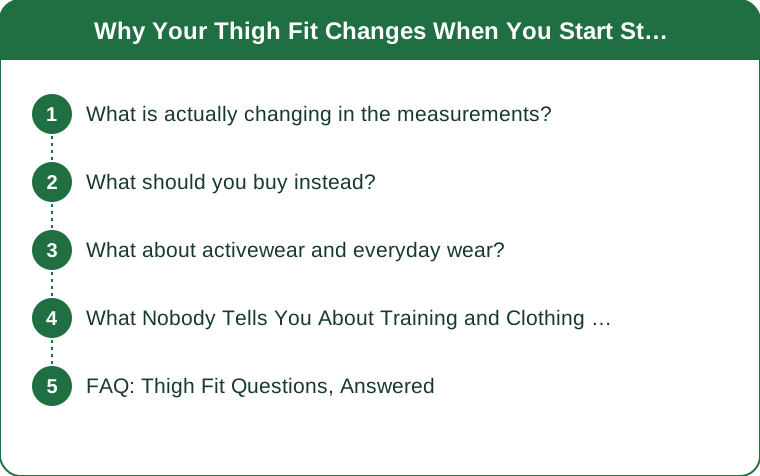
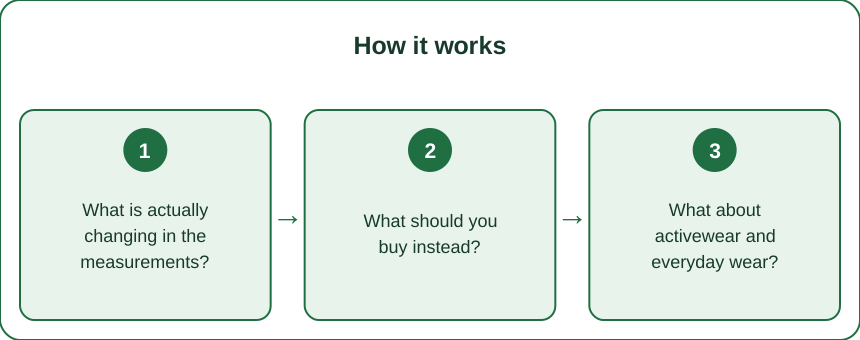
What is actually changing in the measurements?
A specific redistribution that standard sizing does not accommodate.
Muscle grows where it is loaded. Squats, lunges, and hinges load the quads, glutes, and hamstrings hardest, so those are where cross-sectional area increases. The upper thigh and seat change most, and they change first.
The waist often does not follow. Trunk muscles do not add much circumference, and if body composition improves the waist may reduce. A larger thigh with an unchanged or smaller waist is the classic result.
Standard grading assumes a fixed ratio. Going up a size adds circumference everywhere in a fixed proportion. There is no size that adds thigh without adding waist in most ranges, which is the entire problem.
Which produces the specific failure pattern. Tight at the thigh, gaping at the back of the waistband, and pulling across the seat. Three symptoms, one cause.
And the timeline is faster than people expect. Meaningful changes in thigh circumference can appear within a few months of consistent training. The jeans that fit in spring genuinely may not fit in autumn.
Some of it is also temporary. Muscles hold extra fluid and glycogen after training, which produces a real but transient increase. Clothes fit differently the day after leg day, which is normal and not a permanent change.
What should you buy instead?
Different cuts, different fabrics, and a different sizing strategy.
Buy for the largest measurement and alter the rest. Taking in a waistband is a cheap and standard alteration; letting out a thigh usually is not possible. This direction is the whole strategy.
Choose cuts with room through the thigh. Straight, relaxed, bootcut, and wide-leg all give the thigh room without requiring a larger waist. Skinny cuts are the hardest to fit on this proportion by a wide margin.
Prefer fabrics with real stretch and recovery. Denim with a meaningful elastane content accommodates a muscular thigh and returns to shape. Rigid denim with no stretch is the least forgiving option available.
Look for brands that cut for athletic builds. Some ranges explicitly grade with a larger thigh-to-waist ratio, and once you find one they solve the problem outright. This is worth searching for specifically rather than hoping a standard brand works.
Check the rise. A higher rise sits at the narrowest part of your waist and reduces the back gap significantly. A low rise on this proportion puts the waistband at the widest point of your hip and guarantees the gap.
And measure your thigh at the widest point. Most people do not know this number, and brands that publish thigh measurements exist. Knowing it turns online shopping into a comparison rather than a series of returns.

What about activewear and everyday wear?
Different failure points, and a few specific fixes.
Leggings usually cope well, until the seam placement is wrong. A crotch seam sitting too far forward or a flat inseam that runs directly along the inner thigh will chafe and wear through. Look for a gusset, which moves the seam away from the friction point.
Inner thigh wear is a real durability issue. More contact means more abrasion, and the inner thigh of any trouser is where things wear out first. Buy two of anything you wear often and rotate them.
Shorts length matters more than it did. Very short inseams ride up and cause friction. A slightly longer inseam solves both problems and reads as intentional.
Boots need shaft width, not just calf width. Riding boots and knee-high styles frequently fail at the widest point. Wide-shaft ranges exist and are the reliable answer.
Dresses ride up more. Friction between thighs pushes a hem upward while walking. A slip underneath, or a lined dress, removes the effect entirely.
And chafing has a straightforward fix. A barrier balm or a pair of shorts underneath. This is a solved problem and nobody should be uncomfortable about it - if the skin is broken or persistently irritated, that is worth seeing someone about. This is general information, not medical advice.
What Nobody Tells You About Training and Clothing Sizes
The scale is a poor guide to what your clothes will do. Body composition changes can leave weight unchanged while measurements shift substantially. The tape measure tells you more than the scale, and it is the number that predicts fit.
Different exercises change different things. Heavy squats and hip thrusts change the thigh and seat most; deadlifts and running change them differently. Your fit problem is shaped by your programme, which means you have some say in it if you care.
Post-training swelling is temporary and real. Fluid and glycogen in the muscle can make a noticeable difference for a day or two after hard leg work. Do not size up based on a day-after fitting.
Alterations are far cheaper than replacement. Taking in a waistband is one of the simplest jobs a tailor does. Two alterations cost less than one new pair of jeans and give you a fit no off-the-rack size will match.
The proportion you are building is common and badly served. It is not unusual - it is just outside the grading assumption most brands use. The problem is the size chart, not your body, and saying that plainly matters.
And this proportion works with a lot of cuts. Wide-leg, straight, and bootcut all suit a fuller thigh, and the current market is full of them. The narrow-cut era was the hard one, and it has largely passed.
FAQ: Thigh Fit Questions, Answered
How do I measure my thigh properly?
Standing, at the widest point of the upper thigh, with the tape snug but not tight. Do it on a rest day rather than after leg training so you get your baseline rather than a temporary reading.
Will my thighs keep getting bigger indefinitely?
No - muscle growth slows considerably after the initial period, and most of the visible change happens in the first several months. The fit problem is largely a one-time adjustment, not an ongoing one.
Should I change my training to fit my clothes?
That is entirely your call, and worth being honest about with yourself. But altering a waistband costs very little, and a wardrobe that fits the body you are building is generally the better trade.
TL;DR:
- Strength training adds mass to the thigh and seat while the waist stays the same or shrinks.
- Standard grading assumes those measurements scale together, which is why one garment fails in three places at once.
- Buy for the thigh and take in the waist - the reverse alteration usually is not possible.
- Straight, bootcut, and wide-leg cuts work far better than skinny; stretch denim with recovery helps.
- Measure your thigh on a rest day - day-after-leg-day is a temporary reading.
Measure your thigh at the widest point this week and note it next to your waist. That ratio explains every pair of jeans that has disappointed you.
See It in Motion
Seen here: High Waist Bootcut Yoga Pants — shop it on bubblelime.com
Keep Reading
This article is for general informational and styling purposes only. Fit, sizing, and product availability may vary.
